INITWIN · Editorial
Software & digital strategy
What an API is and why your business needs one in 2026
A non-technical explanation of integrations, automations and software ecosystems
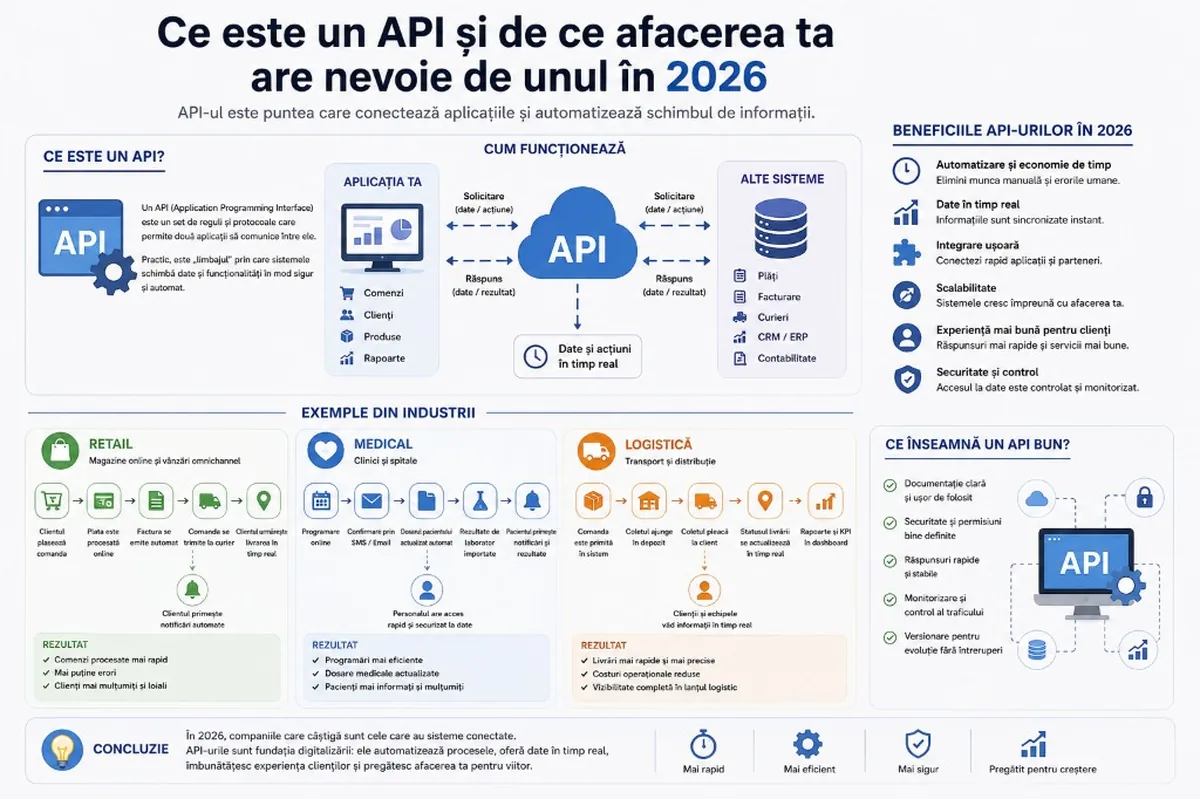
A non-technical explanation of integrations, automations and software ecosystems — what an API is and why it matters for your business in 2026.
In 2025, almost every serious business uses multiple applications: a presentation website, an online store, CRM, ERP, accounting, invoicing, online payments, courier services, email marketing, mobile apps, reports, support platforms or analytics tools.
The problem is not that there are many applications. The problem appears when they do not communicate with each other.
Employees end up copying data from one system to another. Orders are entered manually. Invoices are issued separately. Delivery statuses are checked by phone or email. Reports are built in Excel. Clients ask for information the company already has, but in different systems.
This is where the API comes in. For many companies, API seems like a technical term reserved for developers. In reality, an API is one of the most important tools through which a business becomes more efficient, more connected and more ready for growth. An API is not only a technical feature. It is a bridge between systems — the way applications can communicate automatically, without people moving information manually.
What an API is, explained simply
API stands for Application Programming Interface. In plain language, it is an interface through which two applications can talk to each other.
A simple example: when a client places an order in an online store, the application can automatically send the data to the invoicing system. Then the invoicing system can generate the invoice. At the same time, the application can send the data to the courier company. The courier receives the order, and the delivery status can be sent back to the online store. All of these information exchanges can be done through APIs.
Without an API, an employee would have to copy the order data manually, create the invoice, enter the data into the courier platform and update the status for the client. With an API, these operations can be done automatically.
An API is like a translator and a communication channel between applications. Each system has its own way of working, but through an API it can send and receive information in a format that other systems can understand.
Why APIs matter for businesses in 2025
In 2025, companies no longer compete only through products or prices. They also compete through speed, digital experience, automation and the ability to make decisions based on data.
A client wants to know quickly where their order is. A manager wants up-to-date reports. An operations department wants to eliminate repetitive work. A partner wants access to relevant data. A sales team wants client information to be updated automatically.
APIs allow a business to build a software ecosystem. Instead of each application working in isolation, all important systems can be connected: the website, the internal application, CRM, ERP, accounting, payments, couriers, mobile apps and management dashboards. The result is a more efficient company, with fewer errors and faster processes.
The API as infrastructure for automation
Automation means that certain repetitive actions are done by the system, not by people — not to eliminate the role of people, but to let them work on more important activities.
A company can automate:
- creating invoices after an order is confirmed;
- sending notifications to clients;
- updating stock;
- syncing data between CRM and ERP;
- generating reports;
- updating delivery statuses;
- sending data to accounting;
- sending SMS or email messages;
- validating data entered by clients;
- automatically creating tasks for internal teams.
Without APIs, many of these operations are done manually — lost time, higher costs, risk of error. With APIs, data flows automatically between systems.
Retail example: online store, stock, payments and couriers
At the beginning, things can be simple: the client places an order, someone sees it, issues the invoice, checks stock, prepares the parcel and manually enters the data into the courier app. But as orders grow, this process becomes hard to sustain.
With APIs, the flow can look different:
- The client places the order on the site.
- The system checks stock automatically.
- Payment is processed online.
- The invoice is generated automatically.
- The order is sent to the warehouse.
- Data is transmitted to the courier.
- The client receives an email with the order status.
- Delivery status is updated automatically in the client account.
- The manager sees sales in the dashboard.
This is a clear example of a connected ecosystem. Each application has its role, but APIs help them work together. For retail, APIs can reduce processing time, lower errors and improve the client experience.
Medical example: appointments, records, notifications and results
In healthcare, APIs can connect systems that would otherwise work separately: appointments, patient records, lab results, invoicing, notifications and mobile apps.
A patient can book an appointment online. The system checks the doctor’s availability. The patient receives confirmation by email or SMS. After the consultation, certain documents can be available in the patient account. If there are lab tests, results can be sent automatically to the platform.
For a clinic, this integration reduces phone call volume, lowers the risk of wrong appointments and gives patients a better experience. In healthcare, APIs must be handled carefully — sensitive data, authentication, permissions, security, audit and GDPR. A well-designed API allows controlled access, instead of data being sent through insecure methods.
Logistics example: tracking, routes and real-time statuses
In logistics, the speed of information is essential. A transport company can use APIs to connect orders, couriers, warehouses, maps, mobile apps and notification systems.
When a parcel is picked up, the status updates automatically. When it arrives at a warehouse, the system marks the stage. When it leaves toward the client, the application can send a notification. For the client, the experience is simple: they see where the order is. For the company: fewer calls, more operational control, better delivery data, route optimisation.
In logistics, APIs are not only useful. In many cases, they become mandatory to compete with modern platforms that offer real-time visibility.
Internal API vs external API
Not all APIs are public. Some are internal, used only inside the company. Others are external, available to partners, clients or other applications.
- Internal API — connects the sales application with invoicing, or management with the reporting dashboard.
- External API — allows partners to send orders, check stock, access statuses or integrate the company’s services into their own applications.
For example, a logistics firm can offer an API through which online stores automatically send delivery orders. A clinic can offer integrations for partner labs. A distributor can offer access to stock and prices for resellers. The API thus becomes a collaboration channel with other companies.
The API as a competitive advantage
For some businesses, the API is only internal automation. For others, it can become a competitive advantage. A company with a well-built API can integrate partners more easily, launch new products, connect mobile apps and offer better digital services.
If two logistics firms offer similar services, but one has an API for fast integration with online stores, that firm can become more attractive to B2B clients. If a supplier can offer stock updated automatically through an API, partners can sell more efficiently. In a digital economy, the ability to integrate can be just as important as the product itself.
APIs and mobile applications
A mobile application does not work alone. It needs to communicate with a server, a database and the company’s systems. That communication is done through an API.
For clients: authentication, orders, payments, notifications, documents, statuses. For employees: tasks, reports, locations, forms, operational data. The API is the foundation on which modern mobile apps connected to the business can be built.
APIs and artificial intelligence
In 2025, more and more companies want to use AI: chatbots, recommendations, document analysis, request classification, report generation, intelligent automations. For AI to be useful, it needs access to data and processes — often through APIs.
A support AI assistant can check an order status through an API. A recommendation system can access order history. Without APIs, AI stays isolated. With APIs, it can become a real part of the company’s flows.
What does a well-built API mean?
A good API does not mean only “it works”. It must be clear, secure, stable and easy to use.
- clear documentation;
- authentication and security;
- well-defined permissions;
- predictable responses;
- clear error messages;
- limits to prevent abuse;
- monitoring;
- versioning;
- good performance;
- room to expand.
Documentation lets other developers understand how to use the API. Security protects the data. Versioning helps you change it without breaking existing integrations. A poorly built API can create confusion, errors and risks. A good API becomes solid infrastructure for growth.
Risks and pitfalls
- Lack of security — authentication, permissions, clear rules; not all applications should see all data.
- Lack of documentation — an API that is hard to use and maintain.
- No strategy — every quick integration without architecture leads to chaos.
- Lack of monitoring — you need to know if it works, if errors appear, if traffic is unusual.
The API must be treated as an important part of the software product, not as a final technical detail.
When does your business need an API?
Your business needs an API if:
- you use multiple applications that need to communicate;
- employees copy data manually from one system to another;
- you want to automate invoicing, orders, notifications, deliveries or reports;
- you want a mobile app connected to the company’s systems;
- you work with partners who send or receive data automatically;
- you want a software ecosystem ready for growth.
In other words, an API becomes necessary when the business outgrows the stage where processes can be managed manually.
APIs are not only for large companies
A common misconception is that APIs are needed only for enterprise. SMEs can benefit enormously too: an online store with payments, couriers and invoicing; a services firm with a client portal connected to an internal system; a local clinic with appointments and automatic notifications; a distributor with stock access for partners.
APIs are useful to any company that wants to save time, reduce errors and create better digital processes.
How do you start?
The first step is not to ask for “an API” in the abstract. The first step is to identify the processes that need to be connected.
- What applications do we already use?
- Where do we enter the same data multiple times?
- What operations are done manually?
- What information do clients ask for frequently?
- Which systems need to communicate with each other?
- Which partners might need integration?
- What data must be protected?
After these questions, a software company can propose the right architecture: which APIs are needed, which systems connect, what data is transmitted and what security rules apply.
Conclusion
An API is a bridge between applications — the way software systems communicate, exchange data and automate processes. For a modern business, the API is no longer just a technical term. It is a strategic component.
In retail, APIs connect online stores, payments, stock, invoicing and couriers. In healthcare, they connect appointments, records, results and notifications. In logistics, they connect orders, routes, couriers and real-time tracking.
If your business uses multiple applications, has manual processes or wants to grow digitally, then the question is probably not whether you need an API, but when you build it and how you integrate it correctly into the company’s software strategy.
Keep reading
- Why do my emails go to spam? Complete guide to SPF, DKIM, DMARC and server reputation
- How to build your own company email server with Mailcow, without monthly per-user subscriptions
- How to prepare your team for new software: training, adoption and resistance to change
- Qualified electronic signature in business applications: how to integrate it and what legal effect it has
Need guidance on a similar project or a technical audit?