INITWIN · Editorial
Software & digital strategy
What a day in the life of a developer at INITWIN looks like — team interview
Beyond code: analysis, collaboration, feedback, testing and software solutions built with care
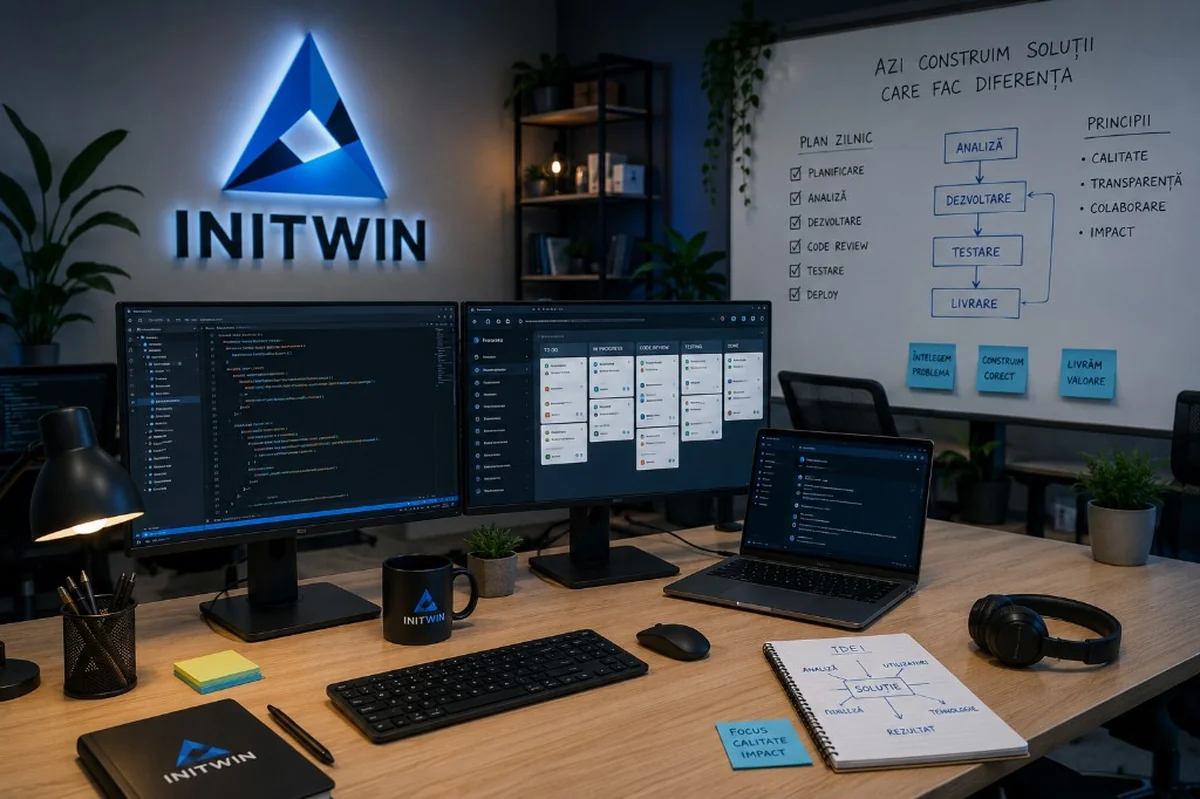
Beyond code: analysis, collaboration, feedback, testing and software solutions built with care — interview with the INITWIN team.
When a client works with a software company, they usually see the final result: a web application, a client portal, a dashboard, an API integration or an internal system that automates processes. But behind every software product there are people: developers, designers, project managers, testers and technical consultants who make small but important decisions every day.
What does a day in the life of a developer at INITWIN actually look like? Is it only about writing code? How much time is spent in meetings? How are technical decisions made? What happens when problems appear? How do you collaborate with the client? And what kind of people fit in a team that builds custom software?
We prepared an interview with the INITWIN team to show the less visible side of software development. It is an honest look behind the scenes of a working day: from morning coffee and planning, to debugging, code review, testing and incremental deliveries.
"The day does not start with code. It starts with understanding context."
Question: How does an ordinary day begin for a developer at INITWIN?
INITWIN Developer: Most often, the day starts with checking priorities. We look at active tasks, feedback from the client, any reported bugs and what needs to be delivered in the next stage. We do not open the code editor and start writing straight away. First we try to understand the context.
If we are working on a client portal, we want to know which flow is affected. If we are working on a dashboard, we check which indicators management needs to see. If we are implementing an integration, we analyse what data is transmitted and what happens if the external API does not respond.
In custom software, code is only the visible part of a decision. Before code, you must understand the problem.
Planning: what we build today and why
At INITWIN, the day usually starts with a short internal sync. It is not a long and complicated meeting, but a quick check of direction.
- What was completed yesterday?
- What is blocked?
- What needs to be clarified with the client?
- Which feature goes into development?
- Are there technical risks?
- Do we need feedback before continuing?
This stage helps the team avoid one of the biggest traps in software development: working in different directions. A developer can write very good code, but if they solve the wrong problem, the value for the client is small.
That is why INITWIN emphasises clarity. Every task must have a purpose. We do not build features just because they "sound good", but because they solve a real need.
"A good developer does not only ask how we do it, but also why we do it."
Question: What matters most in a custom software project?
INITWIN Developer: For us, it matters to understand why a feature is being built. If a client asks for a report, we do not stop at the question "what columns do we put in the table?". We also ask what decision will be made based on that report.
If a client asks for roles and permissions, we want to know how their team works. Who is allowed to see the data? Who approves? Who edits? Who only views?
If a client asks for automation, we want to know what process exists now. Sometimes, before you automate, you need to clarify the process.
A good developer is not just someone who writes code. It is someone who can translate a business problem into a technical solution.
Coding time: real focus
After planning come periods of focused work. This is where code is written, interfaces are built, data models are created, APIs are developed, authentication is implemented, queries are optimised, external services are connected or existing features are adjusted.
For a developer, this is the moment of focus. A seemingly simple task can hide many details.
For example, a client creation form does not mean just a few fields on screen. Behind it there can be validations, business rules, permissions, database saving, audit log, notifications, error handling and integration with other modules.
A "generate report" button can involve filters, aggregations, Excel/PDF export, performance optimisation and access rights verification.
In software, details matter. A good feature is one that works not only in a demo, but also in real situations, with real data and real users.
Code review: nobody works completely in isolation
An important aspect in the INITWIN team is code review. Code is not treated as one person's property. It is a shared responsibility.
Before an important change reaches the application, another colleague reviews it. They look at clarity, security, performance, structure, testability and impact on other modules.
Code review is not about personal criticism. It is about quality.
Sometimes a colleague spots a simpler approach. Other times they see a security risk. Other times they ask whether the solution will scale well. Other times they simply confirm that the implementation is clean and can move forward.
This stage helps the team deliver more safely and learn constantly.
"We like to deliver incrementally, not disappear for three months and come back with a surprise."
Question: How do you collaborate with the client during development?
INITWIN Developer: We try to avoid the model where the client only sees the product at the end. It is risky for everyone. We prefer to deliver in stages: a module, a flow, a testable feature.
The client sees progress, tests, gives feedback and we can adjust earlier. That greatly reduces the risk of misunderstandings.
For us, constant feedback is very valuable. Even if it sometimes means changes, it is better to discover them early than after the entire system is built.
Client meetings: translation between business and technology
An important part of a software team's work is communication with the client. Not all discussions are technical. Often the team must explain options, risks and trade-offs.
For example, a client may ask for a "simple" feature, but in reality it affects multiple modules. The team's role is to explain the impact without useless jargon.
If a change increases development time, the client must know. If an external integration depends on a poorly documented API, the client must understand the risk. If a feature can be left for stage two, the team must recommend the right prioritisation.
At INITWIN, good communication is part of delivery. Software is not built in a black box.
Debugging: the invisible but essential part
There is no software development without problems. Sometimes an integration does not respond as the documentation says. Sometimes real data has exceptions that did not appear in initial scenarios. Sometimes a bug appears only in a specific combination of role, browser and data set.
Debugging is the process through which the team investigates and resolves these problems.
From outside, it may seem that "nothing is happening", because no new visible feature appears. In reality, debugging is one of the most important activities. Application stability depends on it.
A good developer must have patience, attention and discipline. They must look for the real cause, not just cover the symptom.
Testing: "it works on my machine" is not enough
At INITWIN, a feature is not considered finished just because it runs on the developer's laptop. It must be tested in relevant scenarios.
- What happens if the user enters incomplete data?
- If they do not have permission?
- If the file is too large?
- If the external API does not respond?
- If the report has lots of data?
- If the user accesses from mobile?
Good testing means thinking like a real user, not like a programmer who knows exactly what to click.
For business applications, testing is critical. An error in an order flow, a financial report, a document or a permission can create real problems for the client.
Documentation: not the favourite part, but necessary
Many developers prefer writing code, not documentation. Yet in a serious project, documentation is important.
Documentation can explain how an API works, how to configure an integration, how deployment is done, what roles exist, what settings are available or what technical decisions were made.
For the client, documentation helps with use and continuity. For the team, it helps with maintenance. For the future, it reduces dependence on one person's memory.
At INITWIN, documentation is treated as part of project quality, especially for custom applications that must be maintained and extended over time.
"The best day is when you see that a feature really helps the client."
Question: What brings satisfaction in a working day?
INITWIN Developer: The most pleasant moment is when you see that something you built reduces a client's work. For example, a report that used to be done manually in two hours and now generates in a few seconds. Or a portal that reduces repetitive emails. Or an automation that eliminates entering the same data into three systems.
For us, satisfaction does not come only from elegant code. It comes from impact. If the application helps people work better, then the project makes sense.
Team culture: seriousness without rigidity
A working day at INITWIN is not only about tasks. It is also about how the team collaborates.
In a good team, people can ask questions without fear, ask for help, propose solutions and admit when something is unclear. Software is complex enough that nobody should pretend to know everything.
Healthy culture is one where problems are discussed early, not hidden. If an estimate is no longer realistic, it is said. If a technical solution has risks, they are explained. If a task is unclear, it is clarified before implementation.
This transparency helps both the team and the client.
What kind of people fit at INITWIN
A developer suited for INITWIN is not just someone who knows a framework or programming language. Technology is learned and changes. Harder to learn are discipline, communication, curiosity and responsibility.
We look for people who want to understand the problem, not just close the task. People who can work in a team, accept feedback, ask when something is unclear and think about the impact of their work.
In custom software, every project is different. Today you may work on a client portal, tomorrow on an API integration, then on a dashboard, then on a documents module or an AI automation. Curiosity matters.
Why this transparency matters for clients
For clients, it is important to know who they are working with. A software application is not bought like a product off the shelf. It is built through collaboration.
The client needs a team that can listen, explain, recommend and deliver. They need people who do not just say "yes, it can be done", but also explain what it involves, how long it takes, what risks exist and which option is more suitable.
A good software project is the result of a relationship of trust. And trust is built through people, not only through technologies.
Why this transparency matters for future colleagues
For potential employees, such an article shows how the team works. It does not promise a perfect and artificial image, but a realistic one: there is planning, there is code, there are bugs, there is feedback, there is responsibility and there is the satisfaction of seeing the impact of your work.
A developer looking only for isolated tasks may prefer another environment. But someone who wants to build real software products with business impact may find a good growth context at INITWIN.
Conclusion
A day in the life of a developer at INITWIN does not mean only writing code. It means analysis, planning, communication, development, testing, code review, debugging, documentation and collaboration with the client.
It is technical work, but also human work. Because good software is not built only from functions and databases. It is built from good questions, clear decisions, constant feedback and care for the end user.
Behind every application there is a team. And at INITWIN, the team tries to build not only functional software, but solutions that help companies work more clearly, faster and more efficiently.
For clients, that means a technical partner who explains, delivers and stays close to the project. For future colleagues, it means a place where code matters, but equally important is how you think, communicate and build together with others.
Keep reading
- How to prepare your team for new software: training, adoption and resistance to change
- The 8-week MVP: how to launch a product idea without burning the budget
- Artificial Intelligence in a Document Management System: from archiving documents to understanding information
- Sovereign software: developed in Europe, for Europeans
Need guidance on a similar project or a technical audit?