INITWIN · Editorial
Software & digital strategy
Why it costs more to build a cheap project: the real math of technical debt
How the lowest bid can become the most expensive choice in custom software
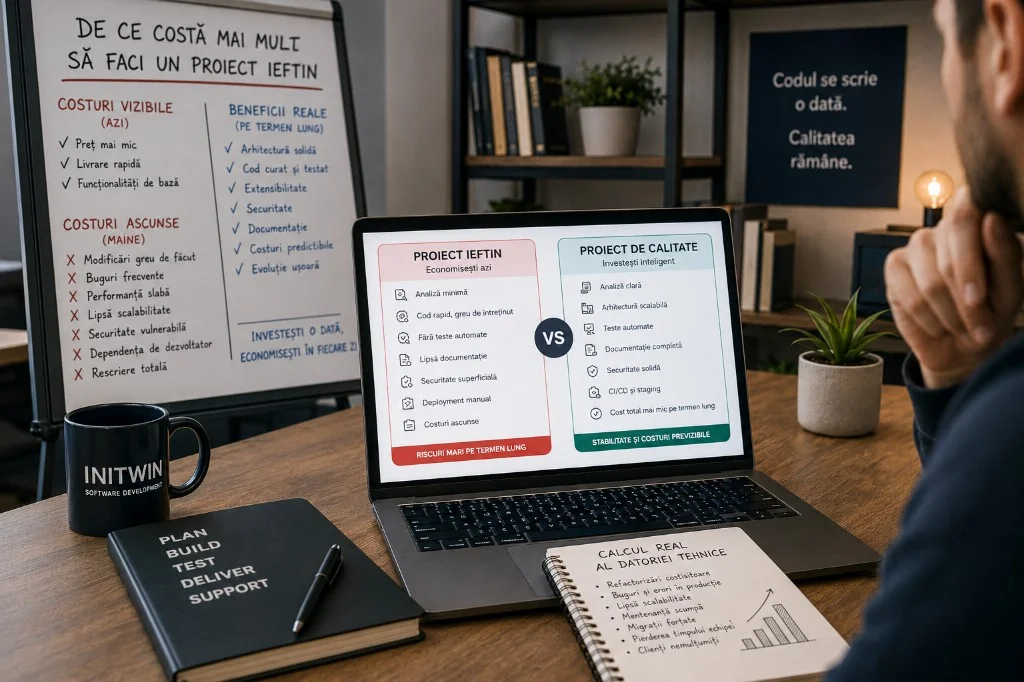
How the lowest bid can become the most expensive choice in custom software.
When a company compares software quotes, the decision seems simple: the same feature list, so price becomes the criterion. If one asks for €8,000, another €15,000 and another €30,000, why pay more?
The problem: in software, two quotes are rarely for the same thing. Login can be built in two days or done properly — validation, brute-force protection, sessions, roles, audit. The gap between “works for now” and “can be used and extended safely” is technical debt.
Technical debt is the hidden cost of fast, incomplete decisions. You save at the start; later you pay through bugs, refactors, expensive maintenance and the inability to extend without breaking what exists.
What technical debt is
Like a loan: you get it now, you pay interest over time. Examples: hard-to-understand code, no tests or documentation, a poorly designed database, superficial security, manual deployment, architecture that does not scale, permissions only in the UI.
At first it is invisible — the demo looks good. With real data and users, the debt surfaces.
Why cheap projects look attractive
A feature list says nothing about quality: login security, optimised reports, 10,000 users, backups, tests, a documented API, another developer can take over the project. Two applications can look the same in the interface and be completely different inside.
Seven false economies
1. No analysis — built on assumptions; expensive refactors when the real flow differs.
2. Weak architecture — every new feature becomes improvisation; “we do not know what breaks”.
3. No tests — every change checked manually; at scale, regressions appear often.
4. No documentation — dependency on the vendor; handover to another team = weeks of analysis.
5. Superficial security — login works, but data is exposed; one incident costs more than the price difference.
6. Chaotic deployment — manual copy to the server vs. staging, CI/CD, backup, rollback.
7. Poorly designed database — works with little data; after months, slow reports, inconsistencies, very costly refactor.
Cost at the first extension and paying twice
“We add ERP, mobile, new roles, audit” — if it was not planned, the answer becomes: rewrite, redo module, change DB. You did not save; you bought a limitation.
Rewrite after a year: first implementation + bugs + takeover analysis + migration + training again. The cheap project can cost 2–3 times more than doing it right from the start.
Example calculation
Quote A: €10,000. Quote B: €25,000. You choose A. After a year: bugs €3,000, painful changes €5,000, documentation €4,000, refactor €8,000, DB migration €6,000 — total €36,000+. B included analysis, tests, documentation, controlled deployment. The initial price is not the total cost.
Dangerously cheap quote — what to ask
- analysis, tests, documentation, security, staging, backup;
- code ownership, maintenance, extension plan, what is not included;
- code review, documented API, changing vendor.
The answers tell you more than the price.
When a cheap solution is worth it
Prototype, idea validation, non-critical data, short lifespan, accepting a rewrite. It becomes dangerous when you treat the prototype as critical enterprise infrastructure.
How INITWIN works
We are not the cheapest bidder — we are the partner who builds responsibly: analysis, architecture, tests, documentation, controlled deployment. Initial cost may be higher; long-term risk, lower.
Conclusion
The cheapest project defers real costs. The right question: how much does it cost to use, maintain and extend the application over the next few years?
Cheap code can become very expensive. Software built correctly from the start can be the best long-term economy — you invest once, you save on every day of maintenance and extension.
Keep reading
- Why do my emails go to spam? Complete guide to SPF, DKIM, DMARC and server reputation
- How to build your own company email server with Mailcow, without monthly per-user subscriptions
- How to prepare your team for new software: training, adoption and resistance to change
- The 8-week MVP: how to launch a product idea without burning the budget
Need guidance on a similar project or a technical audit?