INITWIN · Editorial
Software & digital strategy
Restaurant digitalisation: online ordering, kitchen stock management and daily sales reports
HoReCa solutions: fewer losses, organised orders, food cost and data-driven decisions
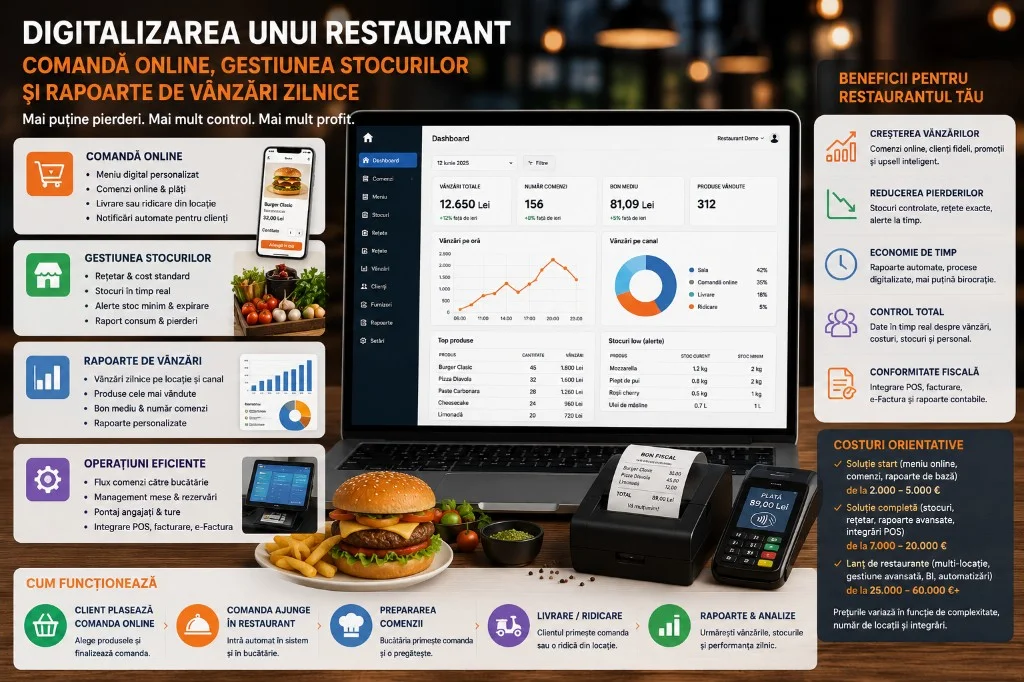
Concrete HoReCa solutions: fewer losses, better organised orders and data-driven decisions.
A restaurant does not only lose money when tables are empty. It also loses money when orders are written down incorrectly, when stock is not tracked, when ingredients expire, when too much stock is ordered, when sales reports are done manually or when the manager finds out too late which products sell well and which only take up space on the menu.
In HoReCa, every day counts. The menu changes, supplier prices shift, staff work in shifts, customers order from the dining room, by phone, online or through delivery platforms, and the kitchen must deliver quickly and correctly. At this pace, a restaurant working with paper, Excel files, WhatsApp messages and end-of-month reports loses control.
Restaurant digitalisation does not necessarily mean a complicated platform. It means order in the flows that consume time and create losses: orders, stock, recipes, sales, deliveries, invoices, reports and internal communication.
Why HoReCa needs digitalisation
Restaurants, cafés, pastry shops, pizzerias, bistros and catering companies operate on sensitive margins. Ingredient costs, salaries, rent, utilities, delivery platform commissions and taxes can quickly reduce profit.
The difference between profit and loss can lie in details: how much stock is thrown away; how many orders are wrong; which products sell best; which dishes have low margin; which suppliers raise prices; which channel brings real profit; which products are out of stock.
Without clear data, the manager decides on impressions. With data updated daily, they can make better decisions. Digitalisation offers control — and in HoReCa, control over orders, stock and sales is essential.
Online ordering: your own channel, not just delivery platforms
Many restaurants depend on delivery platforms. They bring visibility, but come with commissions, their own rules and limited access to the direct customer relationship.
An online ordering module can include: digital menu; categories; options and extra toppings; delivery zones and fees; online or cash on delivery payment; pickup from location; estimated time; order status; notifications; history; discount codes; loyalty campaigns.
For the restaurant, the advantage is control and direct customer relationship. For the customer, simplicity — no phone call and no risk of a wrong order note.
Orders must reach the kitchen correctly
Online ordering is useful only if it quickly enters the operational flow. A restaurant can receive orders from the dining room, phone, website, app, delivery platforms, corporate clients or catering.
If each channel is managed separately, the kitchen becomes chaotic. A digital system can centralise orders with statuses: new, accepted, in preparation, ready, out for delivery, completed, cancelled.
The kitchen sees orders in sequence; waiters see status; the manager sees average preparation time; the customer can receive notifications. This organisation reduces errors during busy hours.
Kitchen stock management
Stock is one of the biggest challenges. Unlike retail, in a kitchen you work with ingredients, weights, waste, recipes, portions and expiry dates.
Without clear management: too much stock is ordered; ingredients expire; shortages during peak hours; real cost unknown; inventory differences discovered too late.
A module can track: suppliers; goods receipts; batches; expiry dates; units of measure; minimum stock; alerts; inventory; consumption per recipe; waste; transfers between locations; cost reports.
Recipe book: the link between menu and stock
Each dish has ingredients and quantities. If the recipe book is in the system, each sale can automatically deduct ingredients from stock.
The manager can see: which ingredients are consumed most; which products have good margin; what needs to be ordered; differences between theoretical consumption and actual inventory; which dishes to adjust in price or portion size.
The recipe book also helps with standardisation — consistent quality and better calculated profitability.
Food cost: the essential indicator
Food cost shows how much ingredients cost relative to the selling price. A dish can be popular but unprofitable — expensive ingredients, portion too large or price not updated after supplier price increases.
A system can calculate theoretical cost based on the recipe book and purchase prices: ingredient cost per product; gross margin; impact of an ingredient price increase; difference between theoretical cost and actual consumption.
Without this information, many restaurants find out too late that they sell a lot but earn little.
Daily sales reports
A manager should not wait until the end of the month. A dashboard can show: total sales; sales by time slot and channel (dining room, online, delivery); top products; average ticket; cancelled orders; discounts; sales by waiter and location; cash vs. card; estimated margin.
Daily reports turn the manager from a reactive administrator into an informed decision-maker.
POS, online ordering and accounting
Ideally, data flows between POS, online ordering, stock, invoicing, accounting, delivery platforms and reports. Without integration, duplications and manual Excel exports appear.
Good integration can mean: online order into POS automatically; sale deducts stock; invoice for corporate clients; updated daily report; data to accounting; everything in one dashboard.
Invoicing, e-Invoice and corporate clients
Restaurants with business clients, catering or events need correct invoicing: invoice generation, tax ID, VAT, history, credit notes, accounting export, e-Invoice integration, archiving. Flows must be validated with the accountant.
Procurement and suppliers
If the system knows minimum stock and average consumption, it can suggest orders to suppliers. An advanced system tracks price history — if an ingredient gets more expensive, you see the impact on dishes.
Bookings, reservations and tables
For dining room service: calendar, tables, number of guests, SMS/email confirmation, client history, notes, private events. Automatic confirmations and reminders reduce forgotten reservations and overlapping tables.
Staff, shifts and productivity
Simple module: shift schedule; time tracking; leave; sales per waiter; performance per shift. Data helps with organisation — which shifts are busy, how many people scheduled, where bottlenecks appear.
How much does restaurant digitalisation cost?
- Simple solution (online ordering, menu, basic reports): €2,000–5,000.
- Medium restaurant (online + POS + stock + recipe book + dashboard): €7,000–20,000.
- Chain / multiple locations: €25,000–60,000+.
Beyond development: hosting, maintenance, support, SMS, payment processor, licences, backup, security. Compare with time saved, reduced losses and extra orders.
What do you automate first?
Do not digitalise everything on day one. Start with the area that hurts most:
- platform dependency → own online ordering;
- ingredient losses → stock and recipe book;
- lack of management data → daily reports;
- kitchen chaos → order flow and statuses;
- procurement → minimum stock and suppliers.
Frequent mistakes
- solution chosen only by price, without fit with the real flow;
- no training for staff;
- recipe book entered without verifying weights;
- no POS integration;
- reports too complex, without clear indicators for the manager;
- no backup and support — a restaurant cannot afford downtime at lunch;
- not analysing monthly costs (SMS, online payments, external services).
Concrete benefits
- organised online orders, fewer errors, faster processing;
- stock control, reduced waste, standardised recipes;
- calculated food cost, daily reports, fast decisions;
- efficient procurement, simple invoicing, informed customers;
- organised staff, managers with real visibility.
Conclusion
Restaurant digitalisation is about control, efficiency and profitability. Your own online ordering reduces dependence on external channels. Stock and the recipe book reduce waste. Daily reports help with fast decisions.
You do not need to implement everything at once. Start with the area that consumes the most time or creates the biggest losses.
In HoReCa, the difference between chaos and control shows every day: in orders delivered correctly, in tracked stock, in clear reports and in decisions made on time.
Keep reading
- Why do my emails go to spam? Complete guide to SPF, DKIM, DMARC and server reputation
- How to build your own company email server with Mailcow, without monthly per-user subscriptions
- How to prepare your team for new software: training, adoption and resistance to change
- The 8-week MVP: how to launch a product idea without burning the budget
Need guidance on a similar project or a technical audit?