INITWIN · Editorial
Software & digital strategy
How we integrate AI into the business applications we build: practical cases, not hype
Support chatbots, automatic document classification, anomaly detection in data and realistic automations for companies
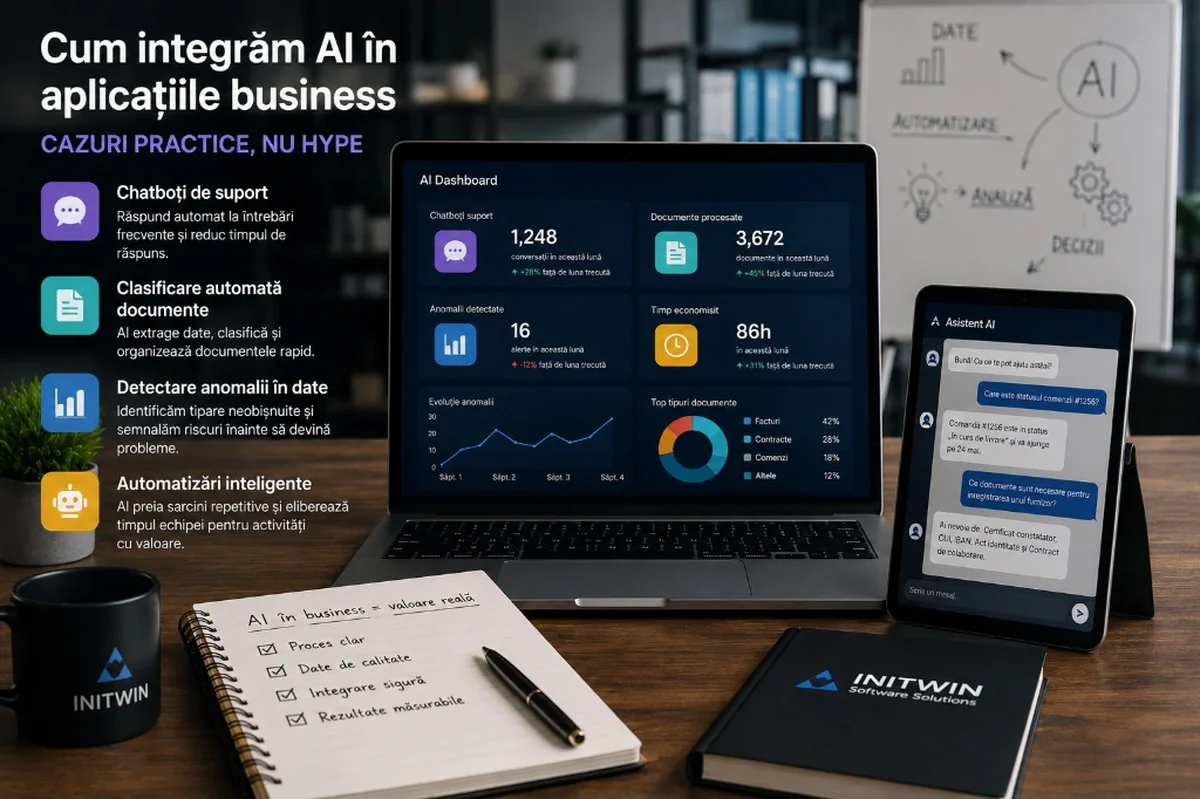
Support chatbots, automatic document classification, anomaly detection in data and realistic automations for companies — AI without hype, with budgets and practical cases.
Artificial intelligence is everywhere in business discussions. People talk about chatbots, automations, AI agents, virtual assistants, predictive analysis, automatically processed documents and faster decisions. For many managers, however, the real question is not "how spectacular does AI sound?", but: what can we do concretely, today, with a realistic budget and clear value for the company?
This is the difference between hype and real implementation.
AI should not be treated as magic that solves any problem. In business applications, AI works best when integrated into a clear process: it receives clean data, has a well-defined purpose, works with security rules and delivers verifiable results. It does not completely replace people, but it can help them work faster, avoid repetitive work and notice things that would otherwise be hard to see.
For a company that builds custom software applications, AI is an additional component in application architecture. We do not build "AI for the sake of AI". We integrate it where it brings value: customer support, document processing, request classification, reports, anomaly detection, intelligent search, recommendations and internal automations.
This article explains, without exaggeration, what can be done today with AI in business applications, what budgets are realistic and what pitfalls must be avoided.
AI in business: what it means concretely
In a business application, AI can have several roles. It can answer questions. It can analyse documents. It can extract data from files. It can classify messages. It can summarise conversations. It can detect unusual values in reports. It can suggest actions. It can generate email or notification drafts. It can help users search for information in the company database.
But AI must not be confused with the application itself. The business application remains the main system: it manages users, roles, data, documents, processes, reports and integrations. AI is a module that connects to this application and helps with certain operations.
For example, in a client portal, AI can answer questions about order status. But the real status comes from the application's database, not from the AI model's imagination.
In a legal system, AI can summarise a document. But the document must be uploaded, secured and correctly associated with a case file.
In a financial application, AI can flag an anomaly. But the final decision must remain with the human specialist.
This is a healthy approach: AI assists, the application controls, the human validates.
Practical case 1: customer support chatbot
One of the best-known scenarios is the support chatbot. Many companies receive the same repeated questions: schedule, prices, order status, required documents, usage instructions, return policies, availability, deadlines, invoices or service information.
An AI chatbot can reduce the support team's workload, especially for simple and repetitive questions.
But a good chatbot should not be just a chat window connected to the internet. For a business application, the chatbot must be connected to the right sources: knowledge base, company documentation, statuses in the application, orders, client account or interaction history, depending on permissions.
Practical examples:
- a client asks "What is the status of my order?" — the chatbot checks in the application and responds with the current status;
- a patient asks what documents to bring to the appointment — the chatbot responds based on clinic rules;
- a B2B client asks how to download an invoice — the chatbot guides them in the portal;
- an internal user asks how to generate a report — the chatbot provides steps based on the internal manual.
Real value appears when the chatbot does not invent answers, but uses company data and respects application rules.
What can realistically be done
You can build a chatbot for frequent questions, integrated with a knowledge base and certain data from the application. Escalation to a human operator can be added when the chatbot is not confident or when the request is sensitive.
Conversation history can be recorded, frequent questions can be analysed and the knowledge base can be improved.
Indicative budget
A simple chatbot connected to a knowledge base can start from a few thousand euros.
A chatbot integrated with the application, authentication, roles, client account data, escalation and reports can reach €8,000–25,000 or more, depending on complexity.
Monthly costs depend on conversation volume, AI model used, infrastructure and support. For moderate use, costs can range from tens to a few hundred euros per month. For large volumes, they can grow significantly.
Practical case 2: automatic document classification
Many companies work with documents: invoices, contracts, requests, notices, CMR documents, medical documents, legal documents, forms, reports, identity documents, forms, offers and emails with attachments.
Traditionally, someone must open the document, understand what it is, rename it, upload it to the correct folder, extract important data and forward it. AI can help with document classification and processing.
For example:
- in a transport company application, AI can identify whether an uploaded document is a CMR, invoice, notice, proof of delivery or another type;
- in a law firm, AI can classify documents by type: contract, notice, ruling, request, defence, correspondence;
- in an accounting firm, AI can extract supplier, date, amount, VAT and invoice number;
- in a clinic, AI can help organise documents received from patients, with strict security rules and human validation.
What can realistically be done
Flows can be built where the user uploads a document and AI proposes the document type, extracts a few important fields and automatically attaches it to the correct entity: client, case file, order, patient, project or invoice.
It is important that the result can be verified. AI can propose, but the user must be able to confirm or correct.
Indicative budget
A simple document classification module can start from €5,000–12,000.
A more advanced system, with OCR, field extraction, validation, database integration, role-based rules and audit, can reach €15,000–50,000.
Monthly costs depend on the number of documents processed, file size, OCR services and AI model used.
Practical case 3: anomaly detection in data
AI is not useful only for text and documents. It can also help with data analysis. Anomaly detection means identifying unusual values or behaviours. It does not necessarily mean something is wrong or fraudulent, but that it deserves checking.
Examples:
- a transport company notices unusual fuel consumption on a vehicle;
- an online shop sees a sudden increase in returns for a product;
- a clinic notices many cancellations for a certain doctor or service;
- a construction company sees material consumption above estimate;
- a financial system detects unusual transactions;
- an order portal notices recurring delays at a certain stage.
AI can help flag these situations before they become major problems.
What can realistically be done
A dashboard with intelligent alerts can be built. The system analyses historical data and flags values outside the norm: costs too high, unusual durations, sudden drops, unexplained increases or repetitive behaviours.
To start, you may not even need very complex AI models. Sometimes simple statistical rules and well-defined thresholds bring immediate value. AI can be introduced gradually as more data becomes available.
Indicative budget
An alerts and anomalies module based on rules and statistics can start from €4,000–10,000.
A more advanced system, with predictive models, history, risk scoring, dashboards and integration with operational flows, can reach €15,000–60,000.
Cost depends heavily on data quality. If data is disorganised, a significant part of the budget will go into cleaning, integration and modelling.
Practical case 4: intelligent search in documents and internal knowledge
In many companies, information exists but is hard to find. Contracts, procedures, manuals, policies, technical documents, offers, emails, reports and files are stored in many places.
AI can help through an intelligent search system. The user no longer searches only by exact words, but can ask questions in natural language.
Examples:
- "What is the return procedure?"
- "What documents must be uploaded for a new client?"
- "Where does the penalty clause appear in the contract?"
- "What are the steps for invoicing a completed trip?"
- "What does the internal procedure say about discount approval?"
Such a system can be very useful for support, legal, sales, operations, HR, logistics or professional services teams.
What can realistically be done
An AI knowledge base can be built that indexes the company's approved documents and responds with references to the relevant source. It is important that the system indicates the document from which it extracted the answer, so the user can verify.
Indicative budget
Intelligent search for internal documents can start from €6,000–15,000.
For large document volumes, complex permissions, automatic updates, integration with internal applications and audit, the budget can exceed €30,000–70,000.
Practical case 5: draft generation and employee assistance
AI can also be useful as an assistant for employees. It does not make decisions for them, but helps them write faster.
Examples:
- draft email to client;
- response to a support request;
- conversation summary;
- description for a report;
- notification for beneficiary;
- case file summary;
- proposed response to a complaint;
- transforming notes into minutes.
This type of AI is useful in applications where people write a lot: customer support, legal, medical, consulting, sales, projects, transport, construction and internal administration.
What can realistically be done
A button can be added such as "generate draft", "summarise", "propose response", "transform into report" or "explain briefly". The user keeps control and can edit the text before sending.
Indicative budget
Simple text generation features can start from €3,000–8,000 if the application already exists.
Integration into a more complex flow, with templates, roles, history, tone rules and approvals, can reach €10,000–30,000.
What should not be fully automated with AI
For a realistic approach, it must also be said what is not recommended.
- It is not recommended for AI to automatically make critical decisions without human validation, especially in fields such as medical, legal, financial, HR or compliance.
- It is not recommended to connect AI to sensitive data without clear security rules.
- It is not recommended to let AI respond to clients on behalf of the company without limits, without sources and without escalation capability.
- It is not recommended to implement AI if data is completely disorganised and the business process is unclear.
- It is not recommended to promise that AI will immediately reduce costs without analysis.
AI is powerful, but it needs context, good data, clear limitations and monitoring.
How we integrate AI into business applications
A healthy integration starts with a simple question: what problem do we want to solve? We do not start with "we want AI". We start with:
- what repetitive activity consumes time?
- what documents are processed manually?
- what questions repeat?
- what data is hard to analyse?
- what decisions would benefit from faster alerts?
- what information is hard to find?
Then we choose the right solution.
In a business application, AI can be integrated through external APIs, cloud-hosted models, privately hosted open-source models or hybrid solutions. The choice depends on budget, data, security, volume and compliance requirements.
For many SMEs, the pragmatic option is integration via API with a mature AI provider, with clear security rules and monitored costs. For companies with very sensitive data or large volumes, dedicated hosting, private models or more controlled architectures can be analysed.
Security, data and confidentiality
Security is one of the most important themes in AI projects. Before sending data to an AI model, it must be clarified:
- what data is sent;
- whether it is personal data;
- whether it is sensitive data;
- where it is processed;
- who has access;
- whether data is stored;
- whether it is used for training;
- how audit is done;
- how permissions are managed;
- what happens in case of incident.
For many applications, a healthy rule is minimisation of data sent to AI. The model should receive only the information necessary for the respective task, not the entire database.
Also, users must know when they interact with AI and when the response must be verified.
Real costs: where the budget goes
In an AI project, budget does not mean only the cost of the model. Costs include:
- process analysis;
- data preparation;
- integration development;
- interface design;
- connection to existing application;
- security and permissions;
- testing;
- monitoring;
- API costs;
- OCR costs, if there are scanned documents;
- hosting;
- maintenance;
- improvements after feedback.
Sometimes the AI part itself is cheaper than correct integration into the company flow. That is why promises like "we do AI quickly and cheaply" must be analysed carefully.
A realistic budget for simple AI features can start from a few thousand euros. For serious integration into business applications, with data, roles, audit and operational flows, budgets frequently reach tens of thousands of euros.
It is important to start with a clear use case, not with a huge AI platform.
How we measure whether AI is worth it
AI must be measured by results, not enthusiasm. Indicators can be:
- time saved;
- number of requests resolved automatically;
- reduction of manual errors;
- shorter document processing time;
- faster invoicing;
- faster support;
- fewer repetitive tickets;
- alerts detected earlier;
- better client satisfaction;
- reduced operational cost.
For example, if a chatbot reduces repetitive support questions by 30%, the value is clear. If a documents module reduces processing time from 10 minutes to 1 minute per document, impact can be calculated. If an anomaly system identifies losses before they become large, the benefit can be significant.
AI must have KPIs, exactly like any other software investment.
Phased implementation: the safest approach
Our recommendation is to start with a pilot. You choose a clear process, a controlled data volume and a measurable objective. You build a first version, test it with real users and measure the result.
Pilot examples:
- internal chatbot for procedure questions;
- automatic classification for a single document type;
- alerts for unusual costs;
- automatic summaries for support tickets;
- intelligent search in an approved document base.
After the pilot works, you extend it. This approach reduces risk, controls budget and avoids large, expensive and unclear AI projects.
Conclusion
AI can bring real value to business applications, but only if used pragmatically. Not every company needs a complex "AI agent". Many companies actually need simpler and more useful things: automatic answers to frequent questions, documents classified faster, data analysed better, intelligent alerts and employees helped with repetitive tasks.
The best use cases are clear, measurable and integrated into existing processes.
A support chatbot can reduce repetitive questions. A document classification system can save hours of work. Anomaly detection can flag losses or risks. Intelligent search can help teams find information quickly. Draft generation can speed up communication.
In the business applications we build, AI is treated as a practical component: integrated, secured, tested and budgeted. Not hype. Not vague promises. But real features with measurable impact for the company.
Keep reading
- Qualified electronic signature in business applications: how to integrate it and what legal effect it has
- The 8-week MVP: how to launch a product idea without burning the budget
- Artificial Intelligence in a Document Management System: from archiving documents to understanding information
- Sovereign software: developed in Europe, for Europeans
Need guidance on a similar project or a technical audit?