INITWIN · Editorial
Software & digital strategy
PostgreSQL vs MySQL vs MongoDB: how we choose the right database for your project
A technical analysis explained for non-technical decision-makers
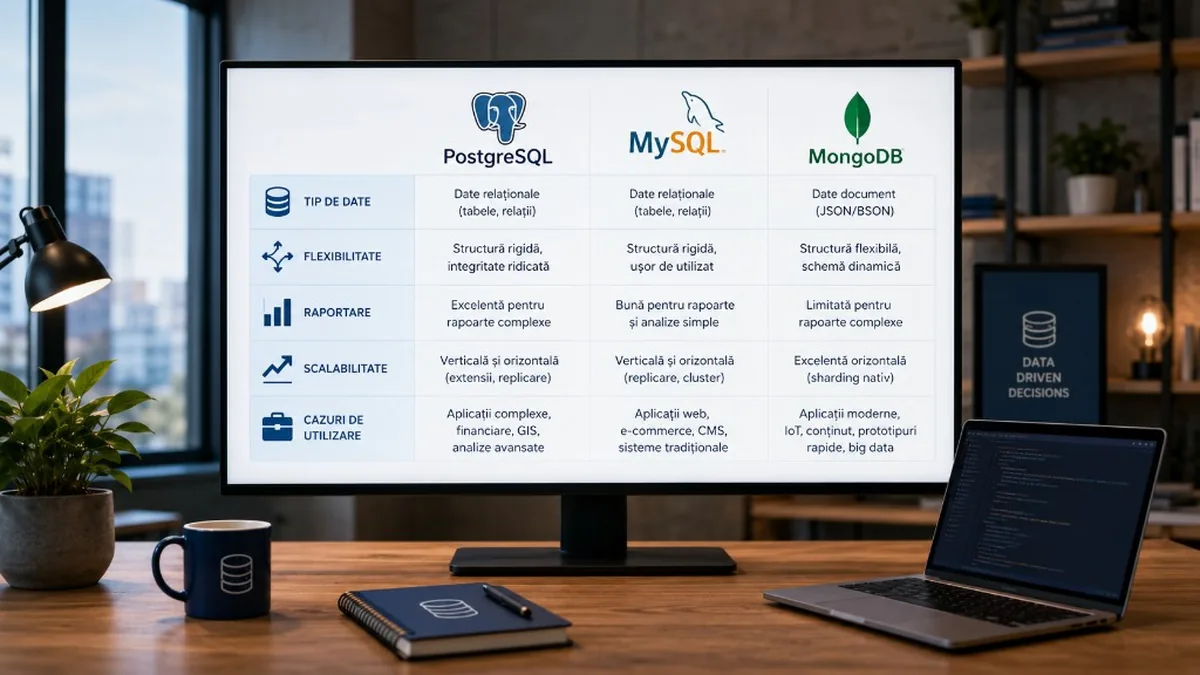
A technical analysis explained for non-technical decision-makers — PostgreSQL, MySQL and MongoDB: differences, scenarios and how to choose the right database.
Choosing the database is one of the most important decisions in a software project. For a non-technical client, it can seem like an invisible choice: the application has screens, buttons, forms, reports and users, but the database stays somewhere “in the back”. Yet that invisible part directly influences application speed, data safety, maintenance costs, scalability and how easily the product can be extended later.
In many technical discussions, three big names appear: PostgreSQL, MySQL and MongoDB. All are mature technologies, used in real projects, from small applications to complex platforms. But they are not interchangeable in every context. Each has strengths, limits and scenarios where it is the right choice.
The correct choice is not made by popularity, fashion or a programmer’s personal preference. It is made according to the project: what data it manages, how structured it is, how important the relationships between data are, what reports must be generated, how many users there will be, what integrations are needed and how much the application may change over time.
Why does the database matter?
A web application is not only the interface the user sees. Behind it there is data: accounts, clients, orders, invoices, products, documents, messages, payments, reports, statuses and activity histories.
The database is where this information is stored, organised and accessed. If the database is chosen wrongly or designed poorly, the application may work acceptably at first, but can become slow, hard to maintain and expensive to change later.
A good choice helps the application stay stable, secure and ready for growth. A weak choice can lead to data loss, reports that are hard to build, poor performance and high refactoring costs.
In short: what is PostgreSQL?
PostgreSQL is a relational, open-source database known for stability, data integrity, advanced features and flexibility. It is often used in business applications, SaaS platforms, financial systems, applications with complex reports, CRMs, ERPs, marketplaces and projects that need well-structured data.
When we say “relational”, it means data is organised in tables that have links between them. For example, an application may have tables for users, orders, invoices, products and payments. An order belongs to a client, has several products, may have an invoice and may have one or more payments. These relationships matter, and PostgreSQL is very good at managing them correctly.
An important advantage of PostgreSQL is that it combines the rigour of a relational database with modern features, including support for semi-structured data through JSONB. That means it can manage both very well-defined data and certain more flexible areas of the application.
When do we choose PostgreSQL?
PostgreSQL is an excellent choice when data is important, relationships are complex and the application must be solid long term. It is suitable for CRM, ERP, client portals, order platforms, financial applications, marketplaces, reporting systems and SaaS.
For example, if you have an application that manages clients, contracts, invoices, payments, orders, stock and user roles, PostgreSQL is usually a very good choice. The reason is simple: all these entities have clear relationships between them, and the system must keep the data correct.
Advantages of PostgreSQL
- seriousness in data management — correct, consistent, easy to query;
- flexibility through JSONB for semi-structured areas;
- advanced features: indexing, complex queries, extensions, text search, geolocation;
- scalability and readiness for future development in custom projects.
Pitfalls with PostgreSQL
PostgreSQL is very powerful, but it must be designed correctly. A poorly thought-out data schema can create problems, even if the technology is good. Excessive use of JSONB — just because it can store JSON does not mean everything should go there. In large projects, indexes, queries and data structure must be planned professionally.
In short: what is MySQL?
MySQL is also a relational database, very popular in web applications. It has been used heavily in websites, online stores, content applications, CMS platforms and digital products that need a simple, fast database known by many developers.
MySQL is a good choice for classic web projects, where the data structure is relatively clear and there are no very complex reporting or advanced relational logic requirements. It is often found in ecosystems such as WordPress, WooCommerce, Magento, PHP applications and many traditional web platforms.
When do we choose MySQL?
MySQL is suitable for dynamic websites, content platforms, classic web applications, standard online stores, simple booking systems, form-based applications, product catalogues and projects where requirements are well understood and relatively common.
If you need a fast web application with standard features, MySQL can be a very good choice. It is well known, has broad support, many compatible tools and a large community.
Advantages of MySQL
- popularity — many developers, frameworks, hosting;
- relatively easy to start, good performance in web scenarios;
- simplicity for projects without very advanced requirements;
- JSON support for flexible data in certain situations.
Pitfalls with MySQL
The biggest pitfall is choosing MySQL only because it is well known. Popularity does not automatically mean the best option. For complex business logic, advanced reports and high integrity, PostgreSQL may be more suitable. Even if MySQL is simpler to start with, the application can become hard to maintain if tables, relationships and indexes are designed superficially.
In short: what is MongoDB?
MongoDB is a document database, from the NoSQL category. Instead of storing data in classic relational tables, MongoDB stores information in documents similar to JSON structures.
For a non-technical client, the difference can be explained simply: in a relational database, data is split into tables and linked together. In MongoDB, data can be grouped into more flexible documents, which can contain varied structures.
For example, a product document can contain the name, price, description, images, attributes, variants and other information in a single structure. Not all documents need to look identical. This flexibility is very useful in certain projects, but can become a problem if used without discipline.
When do we choose MongoDB?
MongoDB is suitable when data is flexible, changes often or does not fit naturally into a rigid table model. It is useful for content applications, catalogues with variable attributes, rapid prototypes, semi-structured data, logs, events and platforms with large volumes of documents.
For example, if each product type has completely different attributes — technical specs vs sizes vs ingredients — MongoDB can be attractive. It can also suit startups testing a product quickly, but that does not mean the schema should not be designed.
Advantages of MongoDB
- flexibility of the data model — different structures, fast evolution;
- natural grouping of data in a single document;
- popular with JavaScript/JSON teams;
- efficient for events, logs, flexible content, prototyping.
Pitfalls with MongoDB
The biggest pitfall is the idea that “we do not need a schema”. Flexibility without rules can lead to chaos — reports that are hard to produce, complicated validations, difficult maintenance. Another pitfall: using it for highly relational applications (clients, orders, invoices, payments, stock, contracts, approvals). MongoDB supports transactions, but should not be used as a classic relational database in every situation.
Simple comparison: PostgreSQL vs MySQL vs MongoDB
| Criterion | PostgreSQL | MySQL | MongoDB |
|---|---|---|---|
| Data type | Relational + JSONB | Relational + JSON | Document (JSON-like) |
| Integrity & transactions | Excellent | Good | Limited vs relational |
| Complex reports | Excellent | Good (standard) | More difficult |
| Schema flexibility | Moderate (+ JSONB) | Moderate | High |
| Scalability | Vertical + extensions | Vertical + replication | Horizontal (sharding) |
| Ideal for | CRM, ERP, SaaS, marketplace | Classic web, CMS, standard ecommerce | Flexible content, logs, prototypes |
PostgreSQL is suitable when the application has important data, complex relationships, advanced reports and a need for strong integrity. MySQL when the project is a classic web application, with a relatively simple structure and standard requirements. MongoDB when data is flexible, semi-structured and the application evolves quickly around complex documents.
There is no universally “best” database. There is a database that fits the context.
Concrete scenarios
Client portal for a services firm
Users, roles, documents, invoices, statuses, notifications, CRM/accounting integrations. PostgreSQL — clear relationships, correct data. MySQL — an alternative if the project is simpler. MongoDB — less suitable for many relationships and reports.
Standard online store
MySQL — very common, especially on existing platforms. PostgreSQL — excellent for custom ecommerce or a marketplace. MongoDB — useful for catalogues with variable attributes, but analysed carefully together with orders and payments.
Marketplace with multiple sellers
Clients, sellers, products, orders, payments, commissions, invoices, returns, disputes. PostgreSQL — a solid choice. MySQL — possible, with careful design. MongoDB — eventually for a flexible catalogue or logs, not as the main database for complex transactions.
Content application or flexible catalogue
Articles, pages, products with variable attributes. MongoDB — a good choice. PostgreSQL with JSONB — a strong alternative, depending on search, filtering and reporting.
Custom CRM or ERP
PostgreSQL — often the best choice: complex relationships, roles, audit, reports, transactions. MySQL — simpler variants. MongoDB — with care; many ERP/CRM systems are naturally relational.
Logs, events, continuously generated data
MongoDB — suitable when each event has a different structure. PostgreSQL — can handle such scenarios. Sometimes a combination: PostgreSQL for main data, MongoDB for events/logs.
Can we use multiple databases in the same project?
Yes, but it is not always recommended. A platform can use PostgreSQL for users, orders, invoices and payments, and MongoDB for logs or flexible content. This approach can be effective in large projects.
However, for an MVP or a medium application, multiple databases can unnecessarily complicate development, backup, monitoring and maintenance. In many cases, it is better to choose one well-designed primary database.
How do we choose the database correctly?
The decision should start from a few simple questions:
- How structured is the data? Clear relationships → PostgreSQL or MySQL. Flexible and varied → MongoDB.
- How important are transactions? Money, invoices, stock → a relational database is usually safer.
- What reports must be generated? Complex ones, aggregations, filters → PostgreSQL is often excellent.
- How much will the model change? Rapid experiment → flexible MongoDB; PostgreSQL covers many hybrid scenarios through JSONB.
- What skills does the team have? Good technology without experience can produce weak results.
Practical recommendation for clients
If you are not sure, do not start the discussion with technology. Start with the business problem: what you want to build, what data exists, who uses the application, what reports matter, what integrations are needed, how much the platform must grow.
For many custom business applications, PostgreSQL is a very solid choice. For standard web applications, MySQL remains mature. For flexible data, documents and logs, MongoDB can be suitable. What matters: the database chosen for the project, not the project forced to fit a choice made out of habit.
Conclusion
PostgreSQL, MySQL and MongoDB are all valuable technologies. The difference is not between “good” and “bad”, but between “suitable” and “unsuitable” for a given project.
PostgreSQL — serious business applications, complex relationships, integrity, advanced reports. MySQL — classic web applications, standard projects, well-known ecosystems. MongoDB — flexible data, documents, varied content, a model that evolves quickly.
A good decision at the start can save time, money and technical problems long term. The right database best supports the application’s goals: safety, speed, flexibility, reporting, scalability and controlled maintenance costs.
Keep reading
- Why do my emails go to spam? Complete guide to SPF, DKIM, DMARC and server reputation
- How to build your own company email server with Mailcow, without monthly per-user subscriptions
- How to prepare your team for new software: training, adoption and resistance to change
- The 8-week MVP: how to launch a product idea without burning the budget
Need guidance on a similar project or a technical audit?