INITWIN · Editorial
Software & digital strategy
Demand forecasting and inventory optimisation with machine learning: how it works for an SME in Romania
AI for distributors and retailers: dead stock, stockouts and better replenishment decisions
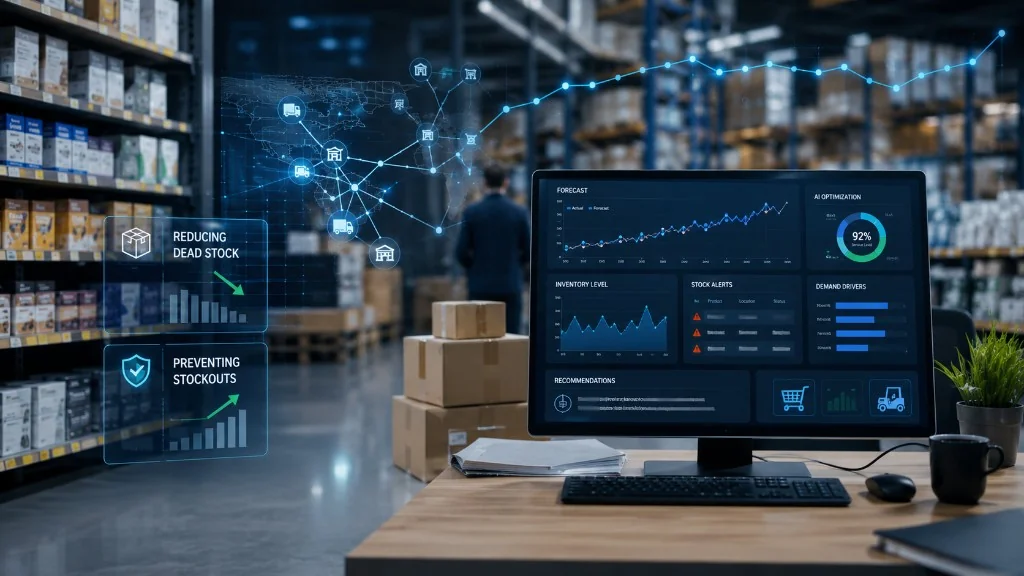
AI applied to real problems for distributors and retailers: less dead stock, fewer stockouts and better replenishment decisions.
For a retailer or distributor, inventory is one of the most important resources. Too much stock ties up cash in goods; too little means lost sales and trust; the wrong stock in the wrong location is the same problem in a different form.
In many Romanian SMEs, decisions come from experience, Excel, sales reps and the manager’s intuition. When the portfolio grows — hundreds or thousands of SKUs, more warehouses, seasonality, promotions — intuition is no longer enough.
Machine learning analyses sales, seasonality, promotions, stock levels and delivery lead times, estimates future demand and recommends better replenishment: less dead stock, fewer stockouts, more control over cash flow.
Too much and too little at the same time
The warehouse can be full and you still lose sales: excess stock on slow movers, shortages on in-demand items, goods stuck in one location and deficits in another. Promotions that drain stock, suppliers that delay — imbalance, not a total lack of goods, is the real pain.
Demand forecasting vs. inventory optimisation
Demand forecasting estimates how much you will sell: water cases next week, auto parts next month, seasonal items before Black Friday, units per warehouse.
A simple model: “last month was 100, so 100 again.” An advanced model: same period last year, active promotion, 10-day lead time, 18% growth over recent weeks → recommendation of 135–150 units.
Inventory optimisation turns the estimate into a decision: how much and when to order, transfers between warehouses, clearance, safety stock, products to protect from stockouts.
Operational examples: “Product A — stockout in 8 days, supplier lead time 12 days, order 300 now.” “Product B — 90 days of stock, declining sales, do not reorder.” “Product C — sells well in Bucharest, stuck in Cluj, transfer recommended.”
Why it matters for Romanian SMEs
Limited resources, no large analytics department — but heavy pressure: pricing, suppliers, cash flow, e-commerce, promotional campaigns. ML can start simple: data from ERP, POS, online store or Excel, on the products that matter (high value, high turnover, dead-stock or stockout risk).
Data required
- sales history, stock levels, prices, promotions;
- supplier lead times, receipts, transfers;
- sales by location, online/offline, returns;
- holiday calendar and seasonality.
Ideally from ERP, POS, WMS — many SMEs start with Excel. The first step is not the model, but cleaning the data: consistent product codes, up-to-date stock, promotions flagged.
ABC products and ML explained simply
ABC analysis: A products (high impact) deserve the pilot. The model learns patterns — better sales on Fridays, growth in December, promotions +40%, higher price → lower demand — and calculates probabilities; it does not guess. The output is a recommendation; the manager adjusts with context the system does not know.
Retailers and distributors
Retail: minimum stock per location, transfers between stores, automatic replenishment for fast movers, clearance of slow products, stockout alerts before campaigns.
B2B distribution: history per client, recurring orders, 45-day lead time, seasonal demand — anticipate needs, avoid reordering after the season. Blocked stock hits cash flow directly.
Safety stock, stockouts and dead stock
Adaptive safety stock: stable sales + fast supplier = small buffer; volatile demand + slow supplier = larger buffer.
Stockouts cost more than one lost sale: unhappy customer, partial order, lost trust in B2B. The system alerts before zero, based on sales pace + stock + lead time.
Dead stock: past season, over-order, replaced model — space, tied-up cash, forced discounting. ML spots declining turnover early; you act sooner and solutions are cheaper.
Dashboard and replenishment recommendations
The manager sees: demand forecast, stockout risk, excess stock, slow turnover, order recommendations, tied-up cash, model accuracy. Operational questions: what to order today, what not to reorder, what to move, what to clear.
Example recommendation: stock 120, estimated 30-day sales 260, order in transit 50, lead time 14 days, safety stock 80 → order 180 units within 3 days. The buyer approves, adjusts or rejects — “AI recommends, humans approve.”
ERP, POS and e-commerce integration
ERP: products, stock, purchases. POS: physical stores. Online: orders and conversions. Daily or weekly updates — in the long run, manual exports limit value.
Accuracy, implementation and costs
The right question: “is it better than our current method?” — not “100% accuracy.” Volatile products = cautious recommendations.
Stages: data audit → cleaning → historical analysis → pilot model (limited categories) → dashboard → validation with buyers → ERP/POS integration → expansion.
- Simple pilot (Excel/ERP export, dashboard): €5,000–12,000;
- Medium (ERP integration, alerts, recommendations): €15,000–40,000;
- Advanced (multi-warehouse, WMS, CRM, simulations): €50,000–100,000+.
ROI and human-in-the-loop
Reduced excess stock (e.g. 10% of €500,000 = €50,000 freed), recovered sales from stockouts, fewer panic clearances, buyer efficiency, availability for customers.
Example: average stock 1,000,000 RON, dead stock 150,000 RON, lost sales from stockouts 30,000 RON/month — 20% less dead stock + 25% fewer stockouts can justify a €10,000–15,000 pilot.
AI does not replace the buyer — they know negotiations, contracts, upcoming campaigns. Human-in-the-loop: the system proposes, the human approves.
Common mistakes
- starting with the model, not the data;
- expecting perfect forecasts;
- treating all products the same;
- ignoring past stockouts (underestimating demand);
- missing promotions and supplier lead times;
- a pretty dashboard without concrete recommendations;
- treating the project as technical only, not business.
What INITWIN can deliver
Data audit, ERP/POS/e-commerce integration, forecasting model, manager dashboard, stockout and dead-stock alerts, replenishment recommendations, accuracy monitoring, maintenance. The value: forecasting reaches the daily decision — what we order, when, what we clear, where we move stock.
Conclusion
Demand forecasting and inventory optimisation are among the most useful AI applications for retail and distribution: a concrete problem, existing data, direct impact on cash flow and sales.
The goal is not to replace the manager’s experience, but to give clearer data and recommendations. Good forecasting does not predict the future perfectly — it shows risks earlier and where money is tied up. For a distributor, that can be the difference between controlled stock and capital locked in the warehouse.
Keep reading
- Why do my emails go to spam? Complete guide to SPF, DKIM, DMARC and server reputation
- How to build your own company email server with Mailcow, without monthly per-user subscriptions
- How to prepare your team for new software: training, adoption and resistance to change
- Qualified electronic signature in business applications: how to integrate it and what legal effect it has
Need guidance on a similar project or a technical audit?