INITWIN · Editorial
Software & digital strategy
Software solutions for real estate agencies: portfolio management, client CRM and automatic listing generation
How to save time, track leads and publish listings faster — portfolio, CRM, AI and portals
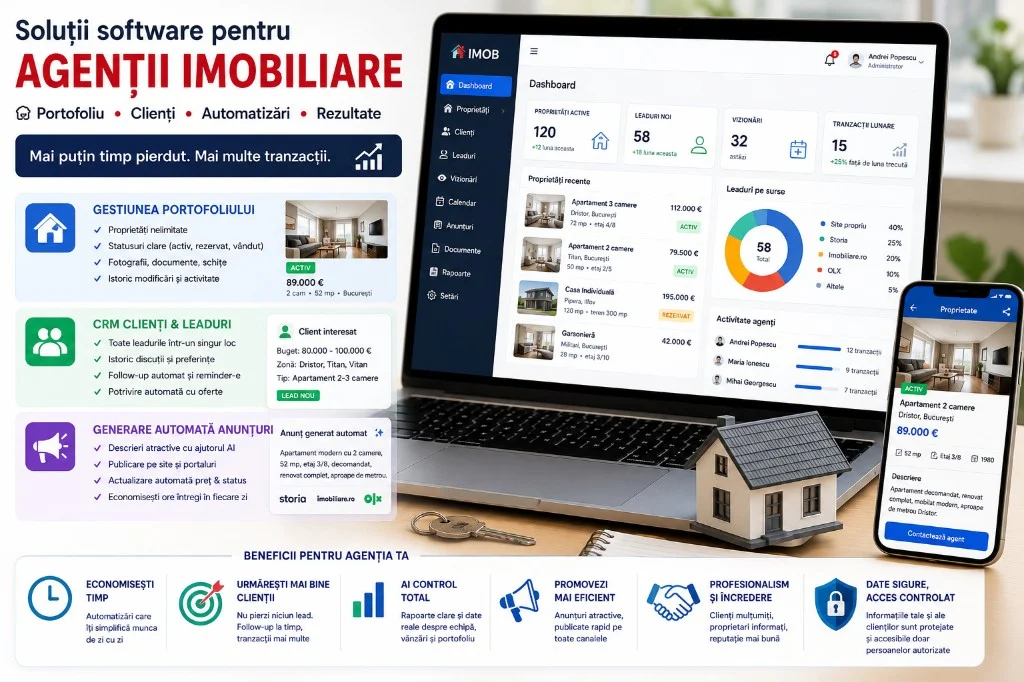
How real estate agencies can save time, track clients better and publish listings faster.
Romania's real estate market is active, competitive and, in many cases, still insufficiently digitalised. Many estate agents work daily with phones, WhatsApp, Excel, notebooks, photos on their phone, listings copied manually to portals, contracts saved in folders and leads lost in conversations.
At first, this way of working seems sufficient. A good agent knows their properties, clients and areas. But as the portfolio grows, problems appear: listings are not updated, sold properties remain published, clients are not called on time, photos are scattered, owners ask for status and the agency manager does not clearly know what is happening with each lead.
In real estate, time matters enormously. A well-built platform can centralise the portfolio, clients, leads, viewings, documents, listings and agent activity — without replacing the human relationship, but eliminating repetitive work and operational chaos.
Why real estate agencies lose time
A real estate agency works with information that changes constantly: prices, statuses, viewings, negotiations, documents, photos. Without a centralised system, information stays in the agent's head or phone.
Frequent problems are simple:
- duplicate properties and outdated listings;
- lost leads and clients called too late;
- no conversation history, photos hard to find, scattered documents;
- no reporting per agent and uninformed owners;
- manual work on portals and lack of control over exclusivity agreements.
These problems do not appear from lack of professionalism. They appear because details are hard to control without a system.
Portfolio management: the foundation of any agency
The first important module is portfolio management. Each property must have a clear record: type, address, area, price, surface, layout, floor, year built, condition, features, photos, documents, owner, status and commercial terms.
A good system lets the agency quickly see which properties are active, reserved, sold or rented, which have exclusivity, which listings need updating and which offers match a particular client.
Clear statuses for each property
In real estate, status is essential: available, in negotiation, reserved, sold, rented, withdrawn, exclusive or awaiting documents.
Real estate software can introduce simple rules: each property has a status; changes are saved in history; public listings update on change; the manager sees inactive properties; agents receive notifications.
Client CRM: who is looking, what they want and when to call
In real estate, a lead is very valuable. If relationships are managed only on the agent's phone, opportunities are lost.
A real estate CRM must keep: client data; interest type (buy, sell, rent, investment); budget; preferred areas; number of rooms; preferences; conversation history; properties sent; viewings; feedback; lead status; responsible agent; next follow-up.
An important advantage is automatic matching between client requirements and the portfolio. If a client is looking for a 3-bedroom apartment in an area, the system can suggest suitable properties — the agent no longer searches manually through dozens of listings.
Automatic follow-up: the difference between a lost lead and a deal
Many sales are lost because follow-up is not done on time. A good CRM can help through reminders and tasks: call the client tomorrow; send a new offer; confirm the viewing; ask for feedback; come back in 7 days; contact the owner for a price update.
These automations do not eliminate the human relationship. On the contrary, they support it — the agent remains the one who negotiates, but the system helps them not forget important steps.
Automatic listing generation
Publishing listings is one of the most time-consuming activities: title, description, features, photos, adaptation for different portals, repetition when price or status changes.
Real estate software can automatically generate listings from the property record. For example, for a 2-bedroom apartment in Dristor, 52 sqm, 3rd floor, renovated, near the metro, €89,000 — the platform can generate a coherent and professional description.
The listing can include: optimised title; full description; advantages; technical details; points of interest; area information; call-to-action; short variants for social media. With AI, texts can be generated quickly and adjusted in tone: premium, direct, professional or investor-oriented.
Publishing on portals and the agency website
A serious agency may have its own website but also publishes on portals. Without automation, every price change must be repeated everywhere.
An integrated system can help through: publishing on the website; export to portals; automatic price update; deactivating sold listings; photo synchronisation; tracking where each listing is published; performance report per channel.
Not all portals allow the same integrations — sometimes API, XML feed or exports. What matters is that the agency no longer depends exclusively on manual copying.
Photos, documents and media materials
Good photos sell better, but managing them can become chaotic. Real estate software can have a media library: photos, video, virtual tour, sketch, floor plan, owner documents, energy certificate, land registry extract, contracts.
Rules can be set: first 5 photos for the listing; private photos for agents only; documents visible only to the manager; images approved for publication.
Relationship with owners
An owner wants to know: how many enquiries, how many viewings, what feedback, whether the price is competitive. A CRM can keep history: listed properties, contracts, exclusivity, price changes, viewings, negotiations, communications.
Periodic reports can be generated for owners — the owner sees that the agent is working actively, not just that they published the listing.
Viewing calendar and activities
An integrated calendar can show: scheduled viewings; responsible agent; client; property; confirmed/unconfirmed status; feedback after viewing; automatic notifications; rescheduling.
The agent, client and owner can receive confirmations. After a viewing, the system can request feedback — activity becomes organised and easy to track.
Reports for the agency manager
A manager needs visibility: leads from which sources; how many contacted; viewings; offers; closed deals; agent performance; inactive properties; areas with demand; effective portals; estimated commissions.
A dashboard can turn the agency from an impression-based activity into a data-driven business — for example, a portal brings many leads but few viewings, or an agent has leads but few follow-ups.
Useful automations for real estate agencies
- new lead from website automatically sent to CRM;
- notification to the responsible agent;
- automatic email to client and follow-up reminder;
- listing generation from property record;
- listing deactivation when status becomes sold;
- alert when a property has not been updated for 30 days;
- weekly report to owner;
- automatic matching between client and properties;
- notification for exclusivity expiry.
AI in real estate: useful, but with limits
AI can generate descriptions, rewrite texts, classify leads, suggest suitable properties or help with messages to clients. But AI must not invent information — if the apartment has no parking, the system must not suggest that it does.
AI must be connected to correct data and used with human validation. The agent approves the final text but saves time on drafting.
Own website for the agency
Many agencies depend too much on external portals. A website integrated with CRM can automatically display active properties, collect leads, promote exclusives and strengthen the brand.
Advantages: control over presentation; direct leads; local SEO; landing pages by area; CRM integration; form for owners; conversion reports. Ideally, a property entered in CRM is published on the website without manual copying.
Standard or custom software?
Standard real estate CRM solutions may be sufficient for small agencies. Custom software becomes interesting when the agency has specific flows, integrations, large teams, custom reports, advanced website, AI or automatic publishing on portals.
Realistic implementation
Good implementation starts with process analysis: how properties enter; how listings are published; how leads are collected; how follow-up is done; how reporting to owners works.
The first version can include: properties; clients; owners; leads; viewings; listings; tasks; simple reports. Later: automations, portals, AI, advanced dashboards.
Concrete benefits
- centralised portfolio and fewer wrong listings;
- better tracked leads and timely follow-up;
- organised viewings and fast listing generation;
- reports for owners and dashboard for management;
- higher productivity, professional image, data-driven decisions.
Conclusion
Real estate agencies work in a fast environment full of information. Without suitable software, agents lose time on repetitive tasks: copying listings, searching for photos, updating statuses, tracking leads and manual reporting.
A well-built system can centralise the portfolio, organise clients, automate follow-up, generate listings and give the manager clear reports. Technology does not replace the agent — relationship and negotiation remain essential. But software eliminates the chaos behind the scenes.
For agencies that want to grow, digitalisation is no longer just an option. It is the difference between reactive work and professional portfolio management.
Keep reading
- Why do my emails go to spam? Complete guide to SPF, DKIM, DMARC and server reputation
- How to build your own company email server with Mailcow, without monthly per-user subscriptions
- How to prepare your team for new software: training, adoption and resistance to change
- The 8-week MVP: how to launch a product idea without burning the budget
Need guidance on a similar project or a technical audit?