INITWIN · Editorial
Software & digital strategy
Webhook vs polling: how to receive real-time data and why it matters for your application
The architectural difference that can make an application faster, more efficient and easier to integrate
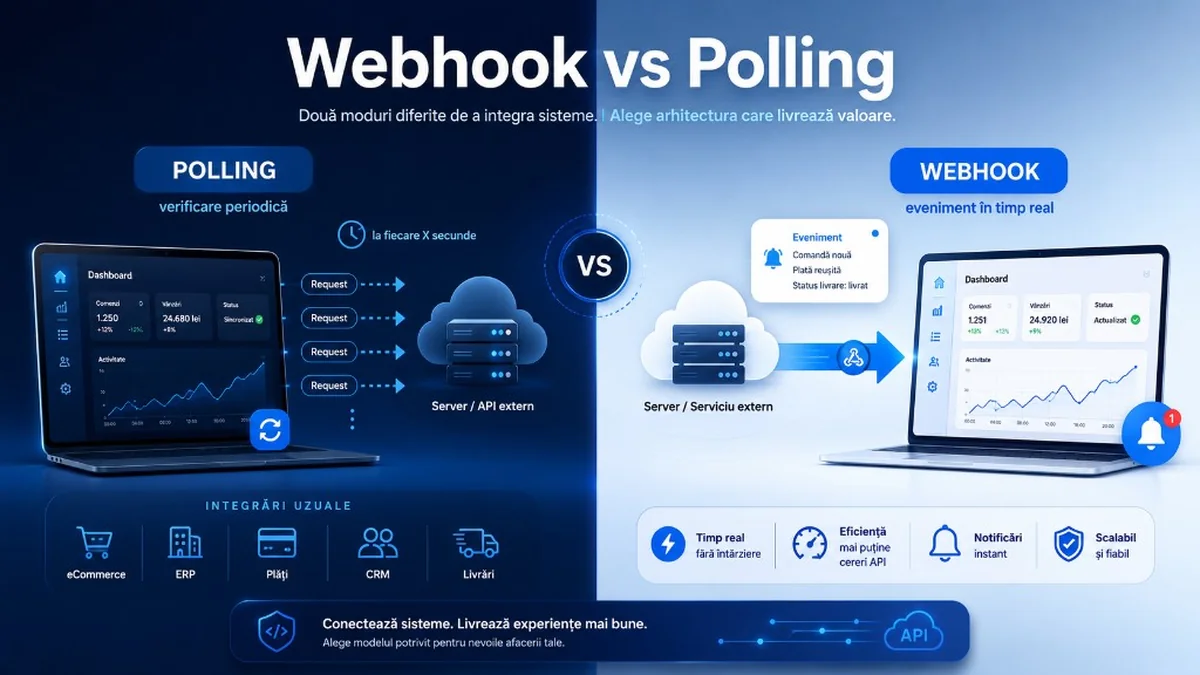
The architectural difference that can make an application faster, more efficient and easier to integrate.
In any modern business application, data flows between systems. An online store must send orders to the ERP. A payment processor must notify the application that payment was confirmed. A courier must update delivery status. A CRM must receive new leads. An invoicing system must transmit when an invoice was issued or cancelled.
The important question is: how does your application find out that something happened in another system?
There are two widely used approaches: polling and webhooks.
At first glance, the difference seems technical. In reality, it directly influences application speed, infrastructure costs, user experience, integration complexity and system reliability.
For entrepreneurs, the difference can be explained simply: polling means your application periodically asks "did something happen?", while a webhook means the external system automatically sends you a message when an event occurs.
For CTOs and technical teams, the discussion becomes more interesting: latency, retry, signatures, idempotency, rate limits, observability, message queues and event-driven architecture.
This article explains the difference in an accessible way, but with enough practical detail for real architecture decisions.
What is polling?
Polling means your application periodically checks another system to see if new data exists.
For example, you have an online store and want to check if new orders appeared on an external platform. Your application can run a job every 5 minutes: "Are there new orders?" If there are, it takes them. If not, it waits another 5 minutes and asks again.
That is polling.
A simple real-life example: imagine you are waiting for a parcel. If you use polling, you go to the courier's website every 10 minutes and check the status. Maybe it changed, maybe not. You check anyway.
In software, polling is often used because it is easy to understand and relatively simple to implement.
What is a webhook?
A webhook is a message automatically sent by one system to another when an event happens.
For example, the payment processor sends your application a message like: "Payment for order #123 was confirmed." Your application receives the message and can update the order, issue the invoice or send a notification to the client.
In the parcel example, a webhook is like an automatic notification: the courier sends you a message when the parcel was picked up, is in transit or was delivered. You no longer need to check manually.
Webhooks are widely used in modern applications for online payments, CRMs, e-commerce, couriers, automation, ERPs, documents, electronic signatures and many other integrations.
The simple difference: repeated question vs automatic notification
The fundamental difference is this:
- Polling: your application periodically asks if there is anything new.
- Webhook: the external system sends you updates when they appear.
Polling is active on your side. A webhook is active on the side of the system that generates the event.
This difference changes how the application behaves.
With polling, there can be delay between when the event occurs and when your application detects it. If you check every 10 minutes, a new order may be picked up immediately or after almost 10 minutes.
With a webhook, the event can arrive almost instantly.
That is why webhooks are preferred when you need fast updates.
Concrete example: online payment
Let us take a very common example: online payment.
A client places an order on the website and is sent to the payment processor. After payment is approved, the application must find out.
With polling, the application periodically checks the processor: "Is payment for order #123 confirmed?" If the check runs every 5 minutes, the client may wait until the system notices the payment.
With a webhook, the processor automatically sends a message to your application: "Payment for order #123 was confirmed." The application updates order status immediately, sends a confirmation email and can start invoicing or delivery flow.
For the client, the experience is faster. For the business, the process is more efficient. For the technical team, the system is closer to real-time.
Concrete example: ERP integration with online store
For a retailer or distributor, integration between ERP and online store can use polling, webhooks or a combination.
If the online store must receive updated stock from the ERP, it can poll: "What is stock for product X?" or "Which products changed since last sync?" This approach may be enough if stock does not change very often or if an update every 15 minutes is acceptable.
But for new orders, a webhook may be more suitable. When a client places an order, the online store immediately sends an event to the ERP: "New order created." The ERP can reserve stock, validate the client, generate the invoice or send status further.
In a good flow, polling and webhooks can work together: webhooks for important events and periodic polling for reconciliation or verification.
Advantages of polling
Polling is not wrong. It has real advantages.
- Simplicity: easy to implement — a job that runs at regular intervals.
- Control: your application decides when and how often to check.
- Compatibility: some older systems do not offer webhooks.
- Predictability: you can control request pace and process data in batches.
- Reconciliation: even if you use webhooks, polling can periodically check that nothing was lost.
In many real projects, polling remains useful, especially for legacy systems, old ERPs, file exports or scheduled synchronisations.
Disadvantages of polling
- Latency: data does not arrive instantly.
- Unnecessary resource consumption: the application constantly asks even when there is nothing new.
- Rate limiting: many APIs limit the number of requests.
- Complexity at high volume: thousands of entities to check become costly.
- Worse experience: the client feels delay in payments or statuses.
Polling is good when fast updates are not critical. It becomes problematic when the business requires immediate reaction.
Advantages of webhooks
- Speed: the event is transmitted almost immediately.
- Efficiency: you no longer constantly ask if something new exists.
- Event-driven architecture: reaction to order created, payment confirmed, document signed.
- Scalability: you process events when they appear, not large volumes periodically.
- Better experience: faster statuses and notifications.
Webhooks are excellent for payments, orders, notifications, deliveries, documents, messaging, electronic signatures and modern integrations.
Disadvantages of webhooks
- You must expose a secure public endpoint.
- Error handling: what happens if the application is offline or the message arrives twice?
- Event order can be unexpected.
- More complex debugging: logs, payload, retry.
- Dependence on provider implementation quality.
Webhooks are powerful, but must be implemented correctly.
Webhook security
A webhook is an endpoint that receives data from outside. That is why security is essential.
It is not enough to create an address like /api/webhook/payment and accept any request.
You must verify that the message comes from the correct source and was not modified.
Commonly used methods:
- HMAC signature;
- secret token;
- header verification;
- IP validation where possible;
- HTTPS mandatory;
- payload structure validation;
- controlled logging;
- rate limiting;
- rejecting invalid messages.
A good practice is signature verification. The provider sends a signature calculated from the payload and a shared secret. Your application recalculates the signature and checks if it matches.
Idempotency: why you must support duplicate events
In the world of webhooks, an event can arrive more than once. This is not necessarily an error. Sometimes the provider resends the event because it did not receive clear confirmation.
If your application is not prepared, problems can appear.
Example: you receive the "payment confirmed" webhook twice. If the application processes both messages without checking, it may send two invoices, duplicate the order or start delivery twice.
Idempotency means the same operation can be executed multiple times without producing duplicate effects.
How is it done in practice?
- Save the ID of the received event.
- Check if the event was already processed.
- If yes, do not process it again.
- If no, process it and mark the event as completed.
For webhooks, idempotency is not optional. It is one of the basic rules of a serious integration.
Retry and processing queues
A webhook must be received quickly. But that does not mean all logic must run immediately in the webhook request.
A healthy architecture often looks like this:
- the application receives the webhook;
- verifies the signature;
- saves the event in the database or a queue;
- responds quickly with success;
- processing happens later, in a worker.
This approach is more robust. If processing takes long, you do not block the provider. If an error appears, you can retry the event. If you have high volume, you can scale workers.
Queues such as RabbitMQ, Redis Queue, Celery, SQS or similar systems can be used for asynchronous processing.
For business applications, this architecture is much safer than direct, heavy processing in the webhook endpoint.
Observability: how do you know what happened?
Integrations without logs become hard to maintain.
For webhooks, you should be able to see: which events were received, what payload arrived, what status processing had, what errors appeared, which events were duplicates, which were resent, how long processing took, what data was updated, whether there is backlog in the queue.
For polling, you must see: when the last sync ran, how many records were fetched, what errors appeared, when the next check runs.
Without observability, the integration works only while everything goes well. When a problem appears, the team does not know where to look.
When do you choose polling?
Polling is suitable when:
- the external system does not offer webhooks;
- data does not need to be updated instantly;
- you want periodic synchronisation;
- you work with older systems;
- you need reconciliation;
- volume is small or moderate;
- you can process data in batches.
Good examples: catalogue sync once per night, stock every 15 minutes, daily import from ERP, order reconciliation.
When do you choose webhooks?
A webhook is suitable when:
- you need fast reaction;
- events are important for application flow;
- you want to avoid unnecessary checks;
- the external system offers stable webhooks;
- you work with payments, orders, deliveries, documents or signatures;
- you want event-driven architecture.
Good examples: payment confirmed, new order, document signed, invoice issued, AWB generated, parcel delivered, new lead in CRM.
The best solution: webhook + reconciliation polling
In many serious applications, the best strategy is hybrid.
The webhook receives events in real time. Polling periodically checks that everything is synchronised.
Why do you need both? Because webhooks can fail. They can be lost, delayed, arrive as duplicates or be temporarily rejected. Reconciliation polling periodically checks the external source and compares data.
For example, for payments: the webhook confirms payment immediately; a periodic job checks payments from the last 24 hours. For orders: the webhook sends the new order immediately; a periodic job checks that all orders also exist in the ERP.
This approach offers both speed and safety.
Why does it matter for business?
For a manager, webhook vs polling is not just technical. It has direct business impact.
If payments are confirmed faster, orders are processed faster. If stock is updated correctly, overselling risk decreases. If delivery statuses arrive automatically, support calls decrease. If signed documents are processed immediately, administrative flows move faster.
Good architecture reduces delays, errors and repetitive work.
Why does it matter for the CTO?
For the CTO, webhook vs polling is an architecture decision. Acceptable latency, data volume, rate limits, retry, endpoint security, idempotency, monitoring, scaling, provider dependence, data consistency, operational cost and maintenance complexity must be analysed.
A good CTO does not only ask "how do we receive data?", but also "what happens when something fails?"
Common mistakes
- Polling too frequently without need.
- Webhook without signature verification.
- Missing idempotency.
- Heavy processing directly in the webhook endpoint.
- Missing logs.
- Missing retry mechanism.
- Assuming events always arrive in order.
- Missing reconciliation polling for critical flows.
- Not testing failure scenarios.
- Choosing the method only because it seems easier to implement, not based on business need.
Conclusion
Webhooks and polling are two different methods of receiving data from other systems. Polling periodically asks if there is anything new. A webhook automatically receives an event when something happens.
Polling is simple, controllable and useful for older systems or periodic synchronisations. Webhooks are fast, efficient and suitable for flows that must react almost in real time.
In many business applications, the best solution is a combination of both: webhooks for speed and polling for reconciliation.
For entrepreneurs, this difference matters because it influences client experience, operational speed and reduction of manual work. For CTOs, it matters because it defines integration robustness, security, scalability and maintenance cost.
A good integration is not one that works only in a demo. It is one that works correctly when delays, duplicates, errors, rate limits or unavailable external systems appear.
And that is where the difference shows between a quick integration and a professionally built architecture.
Keep reading
- Why do my emails go to spam? Complete guide to SPF, DKIM, DMARC and server reputation
- How to build your own company email server with Mailcow, without monthly per-user subscriptions
- How to prepare your team for new software: training, adoption and resistance to change
- The 8-week MVP: how to launch a product idea without burning the budget
Need guidance on a similar project or a technical audit?